Looking back at Java evolution since Java 8
Like many developers of my generation, I started programming with Java, and it was also the first language I used professionally (with Java EE projects).
Since then, I have worked on and delivered systems using various stacks (but that’s not the point here 🙂), while still often having at least some part running on the JVM, sometimes with non-vanilla languages and/or ecosystems (for example Scala with Spark for data engineering).
Java has also continued to evolve during that time. Some changes were incremental improvements, while others introduced concepts that had already become familiar in other JVM or non-JVM languages.
I find it useful to look back at this evolution, especially from a developer perspective: what changed in the language itself, what ideas influenced these changes, and how Java adapted while keeping its main constraint: strong backward compatibility and solid ecosystem.
This is an opinionated review, mostly focused on language evolution rather than libraries or tooling.
Before diving in, one clarification: this is not intended to be an exhaustive changelog of every Java release (in this AI era you will find plenty around).
I deliberately focus on the language features and concepts that, in my opinion, have had the most noticeable impact on day-to-day development. Some important platform, library or JVM improvements are therefore only briefly mentioned—or not covered at all.
Java 8: major turning point
🌟 Java 8 was probably one of the biggest evolutions since the beginning of Java.
One of the main goal was to introduce more functional programming concepts while keeping the existing object-oriented model.
Lambda expressions
🌟 Lambda expressions
Before Java 8, passing behavior usually meant creating anonymous classes:
Runnable task = new Runnable() {
    @Override
    public void run() {
        System.out.println("hello");
    }
};
Java 8 introduced lambdas:
Runnable task = () -> System.out.println("hello");
This brought a more functional style to Java, already familiar to many developers through languages such as Scala.
Scala already had first-class functions:
val task = () => println("hello")
The same general idea also exists in languages such as TypeScript:
const task = () => console.log("hello");
The main difference is that Java lambdas are not values with a native function type. They need a target functional interface:
Function<String, Integer> length = s -> s.length();
The lambda becomes an implementation of Function.
This design is more verbose than Scala’s function types, but fits Java’s existing type system.
Functional interfaces
⭐ Functional interfaces
A functional interface is an interface with a single abstract method:
@FunctionalInterface
interface Calculator {
    int apply(int a, int b);
}
Then:
Calculator add = (a, b) -> a + b;
Java also introduced standard ones:
Function<T, R>
Predicate<T>
Consumer<T>
Supplier<T>
This is somewhat comparable to Scala traits containing an apply method:
trait Calculator {
  def apply(a: Int, b: Int): Int
}
but Scala usually uses function types directly:
val add: (Int, Int) => Int = (a, b) => a + b
Kotlin followed a similar direction with SAM (Single Abstract Method) interfaces:
fun interface Calculator {
    fun apply(a: Int, b: Int): Int
}

val add = Calculator { a, b -> a + b }
So Java and Kotlin both use interfaces as the bridge between object-oriented design and lambda syntax, while Scala has a more direct function type model.
Stream API
🌟 Stream API
The Stream API changed how many Java developers write collection transformations.
Before:
List<String> result = new ArrayList<>();

for (String name : names) {
    if (name.startsWith("A")) {
        result.add(name.toUpperCase());
    }
}
After:
List<String> result =
    names.stream()
         .filter(name -> name.startsWith("A"))
         .map(String::toUpperCase)
         .toList();
The concepts are very close to Scala collections:
val result =
  names
    .filter(_.startsWith("A"))
    .map(_.toUpperCase)
The main ideas are the same:
- composable transformations
- lazy evaluation (until terminal operation)
- declarative processing
The difference is that Scala integrates these concepts much deeper into collections, while Java keeps Collection and Stream as separate abstractions.
Default methods in interfaces
⭐ Default methods in interfaces
Before Java 8, adding a method to an interface was a breaking change, as existing implementations would suddenly miss the new method.
Java 8 introduced default implementations:
interface Logger {
    default void info(String message) {
        System.out.println(message);
    }
}
This looks close to Scala traits:
trait Logger {
  def info(message: String) =
    println(message)
}
but the intent was different.
Java default methods were mainly introduced to allow evolving existing APIs (Collection, for example), not to create a complete trait system.
Java interfaces still cannot have:
- instance state
Also, introducing implementation in interfaces raised the well-known diamond problem from multiple inheritance.
For example:
interface A {
    default void hello() {
        System.out.println("A");
    }
}

interface B {
    default void hello() {
        System.out.println("B");
    }
}

class C implements A, B {
}
This is rejected by the compiler because Java cannot guess which implementation should win.
The conflict must be explicitly resolved:
class C implements A, B {

    @Override
    public void hello() {
        A.super.hello();
    }
}
Java chose explicit resolution rather than Scala-style trait linearization rules, keeping interface inheritance more predictable.
Method references
🔹 Method references
Java added a shorter way to refer to existing methods:
names.forEach(System.out::println);
instead of:
names.forEach(name -> System.out.println(name));
This is close to Scala’s ETA-expansion: converting an existing method into a function value.
Java 9: smaller but important changes
Private methods in interfaces
🔹 Private interface methods
Once interfaces could contain default methods, duplication became possible:
interface Logger {

    default void info(String msg) {
        // formatting logic
    }

    default void warn(String msg) {
        // same formatting logic
    }
}
Java 9 added private interface methods:
interface Logger {

    default void info(String msg) {
        log("INFO", msg);
    }

    private void log(String level, String msg) {
        System.out.println(level + msg);
    }
}
This is mainly an extension of default methods.
Modules
⭐ Java modules
Java 9 also introduced the module system:
module my.application {
    requires java.sql;
    exports my.api;
}
This is less a language evolution and more about:
- packaging
- dependency boundaries
- runtime encapsulation
It mainly affects the JVM platform itself, but naturally benefits JVM-based languages as well.
Java 10: local variable inference
🌟 Local variable inference (var)
Java introduced:
var users = new ArrayList<User>();
The compiler infers:
ArrayList<User> users = new ArrayList<User>();
Important: Java remains statically typed.
The goal was not to introduce dynamic typing, but to remove unnecessary repetition.
For example, TypeScript also has type inference:
const users = new Array<User>();
while remaining statically typed.
Java also supports:
final var users = new ArrayList<User>();
which is close to Scala’s:
val users = ArrayBuffer[User]()
As simple as it looks, this was a significant developer experience improvement.
One of the usual criticisms of Java has always been verbosity, especially compared with languages with stronger type inference.
var removed a lot of unnecessary repetition while keeping static typing.
There are still some inference cases where Java is more limited than languages such as Scala or Kotlin.
For example:
var f = x -> x + 1;
does not compile because the lambda still needs a target functional interface:
Function<Integer, Integer> f = x -> x + 1;
Java inference is therefore intentionally conservative: it helps remove redundant information, but does not try to infer everything.
Java 14+: moving toward a more expressive language
Switch expressions
🌟 Switch expressions
Traditional Java switch was statement-oriented:
String result;

switch(day) {
    case MONDAY:
        result = "work";
        break;
}
Modern Java:
String result =
    switch(day) {
        case MONDAY -> "work";
        case SUNDAY -> "rest";
    };
This is closer to Scala’s match expressions:
val result = day match {
  case Monday => "work"
}
This evolution was also an important step toward pattern matching in Java.
Text blocks
🔹 Text blocks
Java added multiline strings:
String json = """
{
  "name": "John"
}
""";
This removes a lot of escaping and makes embedded content easier to read.
The idea is similar to multiline string literals available in other languages, including Scala:
val json =
"""
{
  "name": "John"
}
"""
A relatively small feature, but a noticeable improvement when working with SQL, JSON, XML, or other embedded formats.
Records
🌟 Records
Records are probably one of the most visible language improvements.
Before:
final class Point {
    private final int x;
    private final int y;

    // constructor
    // getters
    // equals
    // hashCode
    // toString
}
After:
record Point(int x, int y) {}
This is very close to Scala case classes:
case class Point(x: Int, y: Int)
Both provide:
- concise data representation
- generated equality
- generated string representation
- immutable components
Java records are intentionally more limited. They are mainly data carriers, not a replacement for normal classes.
They also integrate well with newer language features such as pattern matching:
record Point(int x, int y) {}

if (obj instanceof Point p) {
    System.out.println(p.x());
}
Pattern matching
🌟 Pattern matching
Java progressively introduced pattern matching.
Before:
if (obj instanceof String) {
    String s = (String) obj;
    System.out.println(s.length());
}
After:
if (obj instanceof String s) {
    System.out.println(s.length());
}
Later, pattern matching was extended to switch:
switch(obj) {
    case String s -> s.length();
    case Integer i -> i;
}
This is a style already familiar from Scala:
obj match {
  case s: String => s.length
  case i: Int => i
}
The goal is not only shorter syntax, but also making type-based branching safer and more expressive.
Java continued this evolution with record patterns:
record Point(int x, int y) {}

switch(obj) {
    case Point(int x, int y) ->
        System.out.println(x + y);
}
Pattern matching is probably one of the clearest examples of Java adopting concepts that have been common in functional programming languages for years.
Sealed classes
🌟 Sealed classes
Sealed types restrict inheritance:
sealed interface Shape
    permits Circle, Rectangle {
}

final class Circle implements Shape {}

final class Rectangle implements Shape {}
The idea is:
“These are the possible implementations of this type.”
This is close to Scala sealed traits:
sealed trait Shape

case class Circle() extends Shape
case class Rectangle() extends Shape
Sealed types become particularly useful together with pattern matching because the compiler knows the possible cases.
For example, a future Java version could potentially detect missing cases:
switch(shape) {
    case Circle c -> ...
    case Rectangle r -> ...
}
Java 21: concurrency evolution
Virtual threads
🌟 Virtual threads
Virtual threads are one of the biggest runtime evolutions in recent Java versions.
Traditional model:
1 Java thread = 1 OS thread
Virtual threads:
many JVM threads
        |
 JVM scheduler
        |
 fewer OS threads
Example:
Thread.startVirtualThread(() -> {
    callRemoteService();
});
The idea is related to lightweight concurrency models such as Go goroutines.
It also addresses a problem similar to Node.js’ event-loop model: handling a very large number of concurrent I/O operations efficiently.
The execution model is different though:
- Node.js relies on asynchronous callbacks/promises and an event loop.
- Java virtual threads keep the traditional blocking programming model while multiplexing many virtual threads onto a smaller number of OS threads.
This is particularly useful for I/O-bound workloads:
- HTTP calls
- database queries
- network operations
It does not make CPU-heavy tasks faster.
Like every abstraction, there are also limitations. For example, some operations can still pin virtual threads to carrier threads.
Structured concurrency
⭐ Structured concurrency
The goal is to make concurrent tasks have a clear lifetime.
Without structured concurrency:
Future<User> user = executor.submit(loadUser);
Future<Order> order = executor.submit(loadOrder);
the relationship between parent work and child tasks is mostly manual.
With structured concurrency:
try (var scope =
     new StructuredTaskScope.ShutdownOnFailure()) {

    var user = scope.fork(() -> loadUser());
    var order = scope.fork(() -> loadOrder());

    scope.join();
}
The idea is similar to structured coroutine scopes.
A task started inside a scope should finish inside that scope, making cancellation and error handling easier to reason about.
This follows a broader trend: making concurrency safer by giving it explicit structure instead of managing independent tasks manually.
What Java still does not have
Despite all these changes, Java remains different from some other modern languages.
There are still no native language features for:
- currying
- first-class function types
- Scala-style trait composition
- higher-kinded types
- typeclass mechanisms (such as Haskell typeclasses or Scala 3
given/using) - default arguments
- named arguments
Some of these features are not just syntax improvements. They represent different approaches to abstraction and type systems.
Typeclass-style mechanisms
Java does not have a built-in typeclass mechanism.
A typeclass allows defining behavior separately from a type and letting the compiler select the appropriate implementation.
For example, in Scala 3:
trait Show[T] {
  def show(value: T): String
}

def printValue[T](value: T)(using show: Show[T]) =
  println(show.show(value))
The compiler can automatically find the Show[T] implementation.
Java can implement a similar pattern using interfaces:
interface Show<T> {
    String show(T value);
}
and explicit passing:
static <T> void printValue(T value, Show<T> show) {
    System.out.println(show.show(value));
}
This works, but the selection remains explicit.
Kotlin also does not provide a built-in typeclass mechanism. It can approximate some patterns using:
- interfaces
- extension functions
- context receivers
but without compiler-supported instance resolution.
This is a deliberate design difference: Java and Kotlin generally prefer explicit dependencies rather than implicit resolution.
Default arguments and named arguments
Java still does not have default arguments:
def connect(host: String, port: Int = 8080)
or named arguments:
connect(host = "localhost", port = 8080)
The usual Java alternatives remain:
- method overloads
- builders
- configuration objects
For example:
Connection connect(String host) {
    return connect(host, 8080);
}

Connection connect(String host, int port) {
    ...
}
Final thoughts
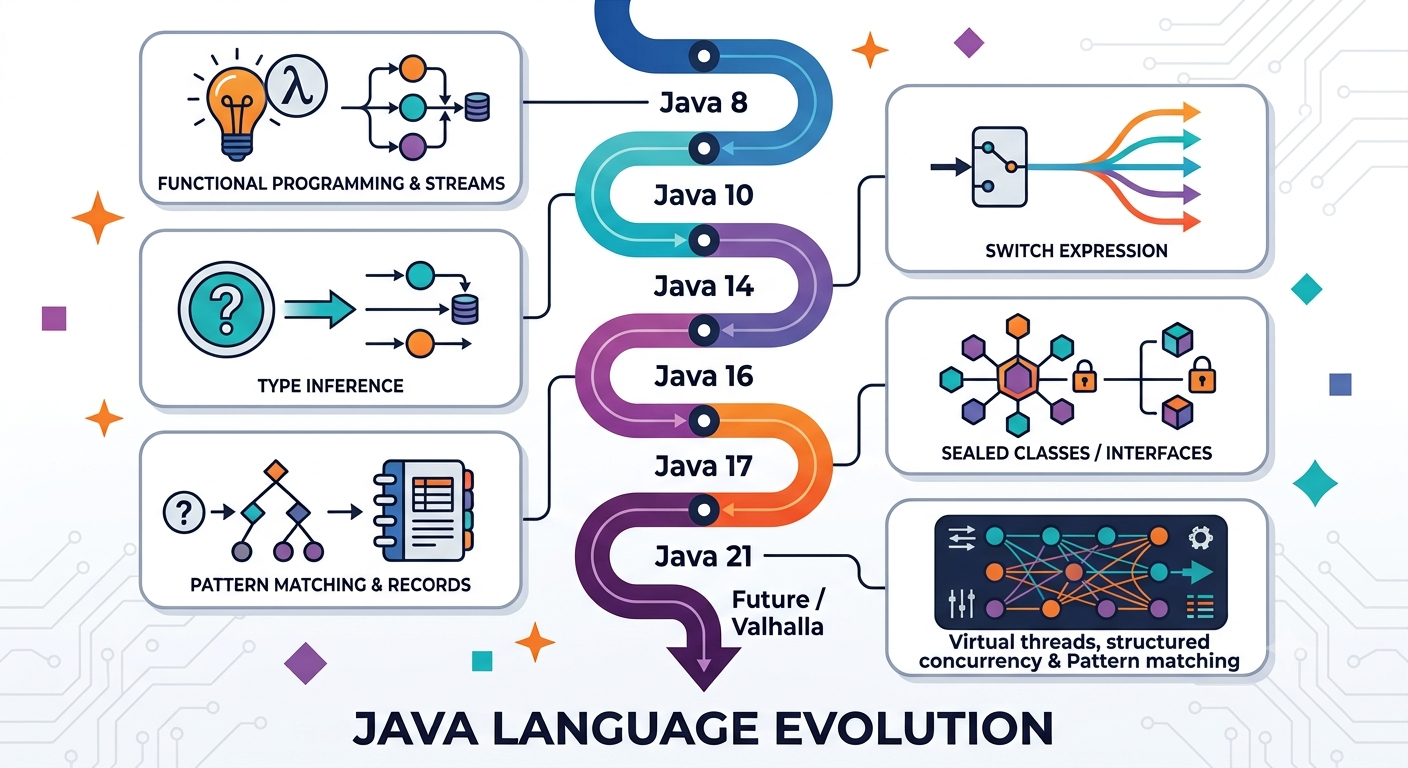
Looking at Java since version 8, the direction is quite clear:
- Java 8 brought functional programming concepts.
- Java 14–17 made the language more expressive with records, sealed types and pattern matching.
- Java 21 modernized concurrency with virtual threads and continued the move toward structured concurrency.
Many of these ideas were already present in other ecosystems, but Java integrated them progressively while keeping compatibility with existing code.
The interesting part is not that Java became another language. It did not.
It gradually adopted concepts that proved useful elsewhere while adapting them to its own constraints:
- explicitness
- backward compatibility
- long-term stability
For JVM developers, the result is that modern Java feels quite different from older versions while still remaining recognizably Java.
What’s next?
Java’s evolution is clearly not over.
A few topics are particularly worth keeping an eye on:
Project Valhalla
Project Valhalla aims to introduce value types (also referred to as primitive classes).
The goal is to improve memory layout and runtime efficiency while keeping an object-oriented programming model.
This could become one of the most significant JVM evolutions since generics.
Pattern matching evolution
Pattern matching is still evolving.
The direction is to make Java type modeling and data processing more expressive, especially combined with:
- records
- sealed types
- exhaustive
switch
The goal is not to turn Java into a purely functional language, but to make common domain modeling patterns less verbose.
Project Loom beyond virtual threads
Virtual threads are only one part of Project Loom.
Other areas, such as structured concurrency, aim to provide better abstractions for concurrent programming.
The broader direction is to make highly concurrent applications easier to write and reason about without forcing every developer into callback-based or reactive programming models.
Continued improvements to type inference
Java has already made progress with var and target typing, but there are still cases where languages such as Scala or Kotlin can infer more.
Further improvements would need to balance:
- reducing unnecessary verbosity
- keeping error messages understandable
- preserving Java’s readability
Looking back at Java’s evolution since version 8, one thing stands out: the language has remained consistent in its philosophy.
Rather than adopting every possible feature, Java has gradually integrated ideas from the broader programming ecosystem and adapted them to its own constraints and priorities.
As someone who still spends a significant part of the time on the JVM, even when using other languages, I find it interesting to step back and look at this evolution as a whole.
Beyond individual features, it also reflects how ideas circulate across programming languages, mature over time, and eventually become part of what many developers consider normal development.